

Table of Contents
- What Is Debt Consolidation?
- What Is an IVA?
- Key Differences Between Debt Consolidation and an IVA
- When Debt Consolidation Might Work
- When an IVA Might Be More Appropriate
- The Impact on Your Credit
- Common Mistakes to Avoid
- Which One Is Right for You?
- Take the Next Step with to PennyPlan
If you’re dealing with multiple debts, rising interest, or payments that are becoming harder to manage, it’s natural to start looking for a way to regain control.
Two of the most common options you’ll come across are debt consolidation and an Individual Voluntary Arrangement (IVA). They’re often mentioned together, but they solve very different problems.
Understanding how they work and when each one makes sense can help you move forward with more clarity and less uncertainty.
What Is Debt Consolidation?
In simple terms, debt consolidation means pulling your existing debts into one place.
You take out a new loan or credit product, use it to clear what you owe across credit cards, overdrafts or loans, then focus on paying that single balance back over time.
On paper, it sounds straightforward. One payment instead of several. One due date to keep track of. That alone can take some pressure off.
Sometimes, it can also reduce interest. That depends on what you’re offered and your credit profile at the time. If your credit score is still in decent shape, lenders are more likely to offer better rates.
But consolidation doesn’t reduce the debt itself. You’re still paying back the full amount. If anything, stretching repayments over a longer period can mean paying more overall if interest is involved.
So while it can tidy things up, it doesn’t change the size of the problem.
What Is an IVA?
An IVA is a different approach entirely.
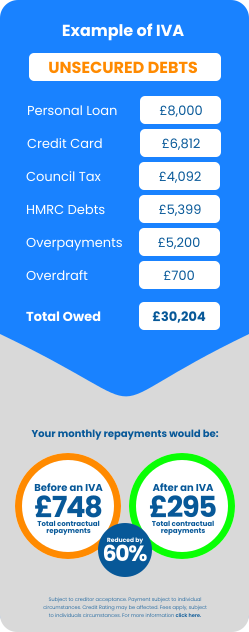
Rather than moving your debt around, it looks at what you can realistically afford to repay and builds a formal agreement around that.
It’s set up by a licensed insolvency practitioner and agreed with your creditors. Once it’s in place, you make fixed monthly payments, usually over five to six years. After that, any remaining debt is written off.
For a lot of people, the biggest shift isn’t just the payment. It’s the structure.
Interest and charges are frozen. Creditors stop chasing. You’re no longer dealing with multiple demands coming in from different directions.
It creates a single plan, based on your situation as it stands, not what lenders expect you to manage.
Key Differences Between Debt Consolidation and an IVA
It’s easy to assume these options overlap, but they sit in very different places. The differences below are what really separate them.
- How much you repay: With consolidation, you repay everything you owe. With an IVA, you repay what you can afford, and the rest is written off at the end.
- Access and eligibility: Consolidation usually depends on your credit score. If your credit has already taken a hit, options can be limited. An IVA is designed for people already in that position.
- Creditor pressure: Consolidation doesn’t stop creditors from taking action if payments are missed. An IVA does. Once it’s approved, creditors have to stick to the agreement.
- Credit file impact: Both affect your credit, but an IVA has a longer and more visible impact. It stays on your file for six years.
- Day-to-day flexibility: Consolidation can feel more flexible. You may be able to overpay or adjust things. An IVA is more fixed, which works well for some people and feels restrictive for others.
When Debt Consolidation Might Work
Debt consolidation tends to suit situations where things are still under control, even if they feel tight.
If you’re meeting your payments but struggling to keep track of everything, combining debts can bring a bit of order back into your finances. It can also make budgeting feel more predictable, especially if you’re working towards a fixed end date.
That said, it only works if the numbers hold up long term.
If the new repayment is still a stretch, or if spending habits don’t change, there’s a risk that balances creep back up again. It’s not uncommon for people to clear credit cards with a consolidation loan, only to use those cards again later.
That’s where consolidation can start to work against you instead of for you.
When an IVA Might Be More Appropriate
An IVA tends to come into the picture when keeping up has already become difficult.
Maybe payments have been missed. Maybe balances are growing faster than they’re being cleared. Or maybe the stress of trying to manage everything is starting to take its toll.
At that point, restructuring debt may not be enough.
An IVA works differently because it accepts that the current situation isn’t sustainable. Instead of trying to stretch repayments further, it resets them based on what’s actually affordable.
That shift can make things feel more stable quite quickly. You know what’s going out each month, and you know when it ends.
For a lot of people, that clarity matters just as much as the financial side.
The Impact on Your Credit
Credit scores tend to come into the conversation early, and understandably so.
With consolidation, the impact varies. A new credit application may cause a dip at first, but steady repayments can help rebuild your profile over time.
An IVA is more visible. It stays on your credit file for six years, and during that time, access to credit will be limited.
But the context really matters here. If you’re already missing payments or dealing with defaults, your credit file may already be affected. In those cases, the priority often shifts. It becomes less about protecting a score and more about finding something that actually works.
Common Mistakes to Avoid
There’s no shortage of advice around debt, but not all of it helps in practice. A few patterns tend to come up again and again.
- Chasing the lowest monthly payment: It’s tempting to focus on what looks affordable now, but stretching debt over longer periods can increase the overall cost.
- Overestimating what you can afford: It’s easy to commit to a figure that works on paper but doesn’t reflect real spending. When things get tight, that’s where plans start to break down.
- Putting things off: Debt rarely stands still. Interest, fees, and pressure from creditors can build over time, which can limit your options later.
- Trying to figure everything out alone: There’s a lot of conflicting information out there. Making a decision without proper guidance can lead to choosing something that doesn’t quite fit.
Mistakes like this usually come from people understandably wanting a quick way to fix things.
Which One Is Right for You?
There isn’t a universal answer, but there is a useful starting point. If you can repay your debts in full, and you have access to reasonable credit terms, consolidation could help you stay organised and in control.
If that’s not realistic, or things are already slipping, an IVA may offer a more practical route. It gives you a structured plan based on what you can actually manage, not what’s expected on paper.
The key is being honest about where things stand now, not where you hope they might be in a few months.
Take the Next Step with to PennyPlan
If you’re weighing this up and still unsure, that’s completely normal.
At PennyPlan, our aim is to understand what’s going on, look at what’s realistically affordable, and talk through available debt solutions.
That might be debt consolidation. It might be an IVA or it might be something else entirely. What matters is finding an approach you can stick to.
Start dealing with your debt today and talk to our team.